Review of The Best Home Gym Equipment Tested for 2026: What Actually Works for Aging Bodies
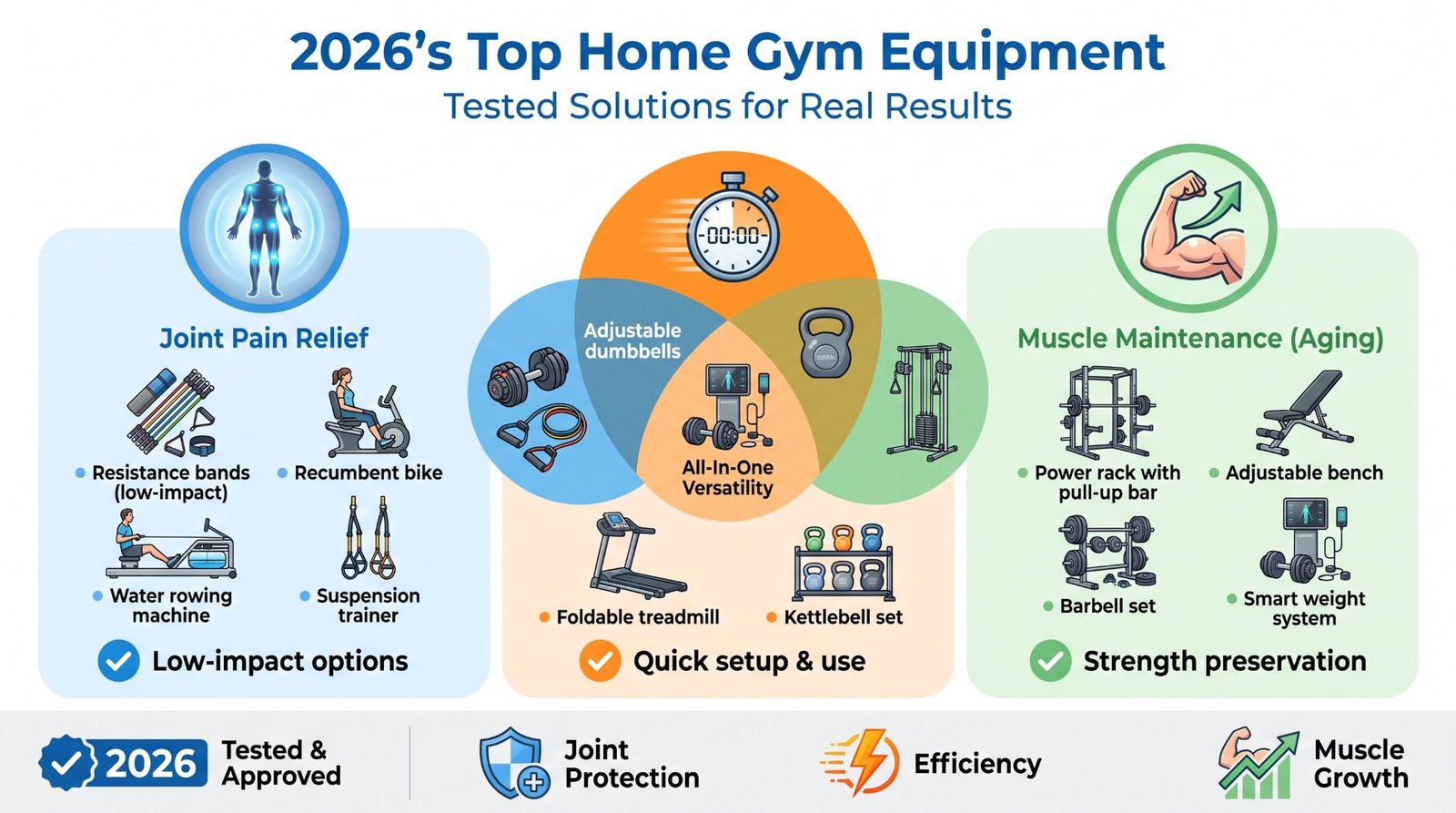
The best home gym equipment for 2026 includes a handful of tested options that work well for people dealing with joint pain, short on time, and trying to maintain muscle as they age. This review covers what actually performed well in testing, what the real trade-offs are, and when the hype matches reality.
Introduction
So here’s the thing… your knees hurt after running, your back feels tight most mornings, and you have maybe 30 minutes between work and family stuff to actually train.
A regular gym membership starts feeling like a waste when you factor in the commute and the fact that half the equipment there doesn’t work for your body anymore.
That’s where home gym equipment comes in, and honestly, the 2026 options are way better than they used to be. We’re talking low-impact stuff that doesn’t wreck your joints, guided workouts you can actually finish in under half an hour, and setups that fit in a spare room or corner of the garage.
Testing labs and fitness sites spent the last year putting these machines through real use to see what holds up and what’s just marketing fluff.
This guide pulls together that testing and focuses on three specific problems:
Joint pain and stiffness, you need equipment that doesn’t beat up your knees, hips, and lower back
No time, you need workouts that are quick and efficient, not 90-minute slogs
Muscle loss, you need strength training that actually works but doesn’t leave you injured for a week
Let me walk through what made the cut, where these products actually shine, where they fall short, and how to piece together a home setup that makes sense for an older body that still wants to feel strong.
What Is The Best Home Gym Equipment Tested for 2026?
There’s no single perfect machine that does everything. Based on what performed well in 2026 testing across many review sites, a few products keep showing up at the top for different needs.
Here’s how the best home gym equipment 2026 breaks down by category.
Smart All-in-One Strength Systems
Tonal 2 is the wall-mounted digital resistance system that keeps winning “best smart home gym” awards.
It uses adjustable digital weight up to 200 lbs with guided strength programs and form coaching built in. The whole thing mounts to your wall, so it takes up way less space than a traditional rack and cable setup.
Programs include short structured routines that fit into 20-30 minutes. That’s huge if you’re juggling work and kids.
Reviewers point out that Tonal automatically adjusts resistance and tracks your progress, which helps older lifters avoid the ego-lifting trap that wrecks joints.
Speediance Gym Monster 2 is the freestanding version of the same idea.
It got picked as best overall home gym equipment by Men’s Journal for 2026. It’s a freestanding unit with cable arms, smart resistance, and built-in full-body workout templates.
The main difference is you don’t have to mount it to the wall, which matters if you rent or want to move it around.
Tonal feels more polished overall, but Speediance gives you similar functionality without permanent installation.
Quick note if you’re considering one of these: compare the upfront cost plus subscription fees before you commit. Sometimes the ongoing monthly charges add up to more than you’d expect over a few years.
Classic Barbell and Rack Setup
If you still like “real weights” and want something that’ll last a decade or more, the REP Fitness PR-1100 power rack keeps showing up in value tests.
It scored an 89 out of 100 in SmarterRankings’ 2026 testing rubric and won best budget power rack in many guides.
The rack handles up to 700 lbs and includes a pull-up bar. Price runs around $380-550 depending on configuration, which is way below average for a quality squat rack.
Paired with a basic barbell and bumper plates, this setup covers squats, bench presses, rows, overhead presses, and pull-ups. That’s pretty much everything you need for serious strength work.
The honest part is that barbell training is harder on joints if your form is sloppy. For aging knees and backs, this setup works best if you’re willing to learn proper technique, progress slowly, and use lighter weights with higher reps on days when your joints feel rough.
I’d check pricing on the REP PR-1100 plus a basic barbell and bumper plate set before sale stock runs out. These things tend to go out of stock during January when everyone’s motivated, then restock in February when half those people have quit.
Adjustable Dumbbells
Adjustable dumbbells made almost every “best of 2026” list because they compress an entire rack of weights into one or two handles.
Popular tested options include:
Bowflex SelectTech 552, goes up to 52.5 lbs per hand, highly rated for general strength training
Bowflex Results Series 1090, heavy adjustable dumbbells that go higher for serious lifting
PowerBlock Sports or Elite, compact footprint with fast weight changes, often picked as best budget sets under $500
REP Fitness QuickDraw, often named best budget adjustable dumbbells in 2026 roundups
Testing shows these perform well for presses, rows, curls, and lunges with enough load for real muscle work.
For aging joints and tight schedules, adjustable dumbbells make sense because you can train all major muscle groups without heavy spinal loading from back squats. You can keep a bench and dumbbells in a corner of a bedroom or office and run a finish workout without rearranging furniture.
Circuit-style sessions (push, pull, legs) are easy to finish in under 30 minutes.
If you mainly want safe strength and muscle maintenance without a full rack, I’d look at current bundle pricing on Bowflex or PowerBlock adjustable dumbbells plus an adjustable bench. Buying them together usually saves you money compared to buying separately.
Low-Impact Cardio, Rowers and Bikes
Cardio equipment is where joint pain usually becomes a problem. High-impact treadmills are rough on knees, so a lot of older users look for rowers and bikes instead.
Rowers
Concept2 RowErg Model D, highly rated full-body rower with strong reliability, scores around 4.8 out of 5 in expert guides
Ergatta Luxe Rower, named best at-home cardio equipment in Men’s Journal’s 2026 awards
Aviron Strong Series, top-rated smart rower with interactive content
Fitness Reality 1000 Plus, best budget rower under $500, with 14 resistance levels and Bluetooth tracking
Rowing spreads the load through your hips, glutes, and back with almost no impact on your knees (assuming your technique is decent).
Bikes
Peloton Bike+ / Cross Training Bike, interactive cycling with guided classes, chosen as best smart bike in many 2026 lists
Indoor bikes let you push your heart rate up with basically zero impact force through your knees and ankles. That’s ideal for aging joints and heavier bodies.
The trade-off is that rowers hit more upper body and core, while bikes are easier to learn and usually feel friendlier if you already have back issues.
Minimalist Kits, Bands and Suspension Trainers
Not everyone needs or wants a big machine.
Several 2026 guides show that a bands plus suspension trainer combo can create a solid functional home gym for well under $500.
Resistance bands are described as the most versatile piece of equipment under $50 and support full-body strength and mobility work.
The TRX Home Suspension Trainer keeps winning “best overall home gym under $500” because it let’s you do pressing, pulling, and core work using your own bodyweight.
Starter setups with bands, a mat, and a pull-up bar can build a functional home gym for under $100-300 depending on where you live.
For aging bodies, bands and suspension trainers work really well because they allow joint-friendly ranges of motion (resistance increases gradually) and make eccentric control (slow lowering) easy. That helps with tendon and joint resilience.
They also require very little space and are easy to pack for travel.
If you’re testing things out before dropping serious money, I’d start with a resistance band set and a TRX-style suspension trainer. Look for combo sets from reputable brands and watch for deals under $200.
Why It’s Trending
A few practical shifts are pushing people toward home gym setups right now.
Reviewers keep showing that you can build meaningful home gyms anywhere from under $100 up to multi-room six-figure builds, with most finish setups landing between $1,000-$2,000.
Guides from different regions show functional starter gyms for 100-300 EUR or under ₹5000, which opens this up beyond premium markets.
Smart systems like Tonal 2 and Speediance add coaching, progression tracking, and short pre-made workout templates. That targets busy professionals who don’t want to spend 20 minutes figuring out what to do each session.
Budget-focused reviews highlight racks, adjustable dumbbells, and bands that punch way above their price point. That makes home setups feel sensible compared to rising gym memberships.
For older lifters concerned about joint pain and muscle loss, the trend comes down to something simpler. People want to control their environment.
A home gym let’s you choose low-impact options like rowers and bikes instead of pounding a treadmill. You can schedule short sessions around family and work without commuting.
You can train strength regularly, which is one of the main tools for fighting age-related muscle and strength decline.
The hype isn’t really about fancy screens or app integrations. A lot of it is just about making consistent training realistic again when life gets complicated.
Pros and Cons
Instead of pretending everything is perfect, here’s a straight look at the main pros and cons of the leading categories.
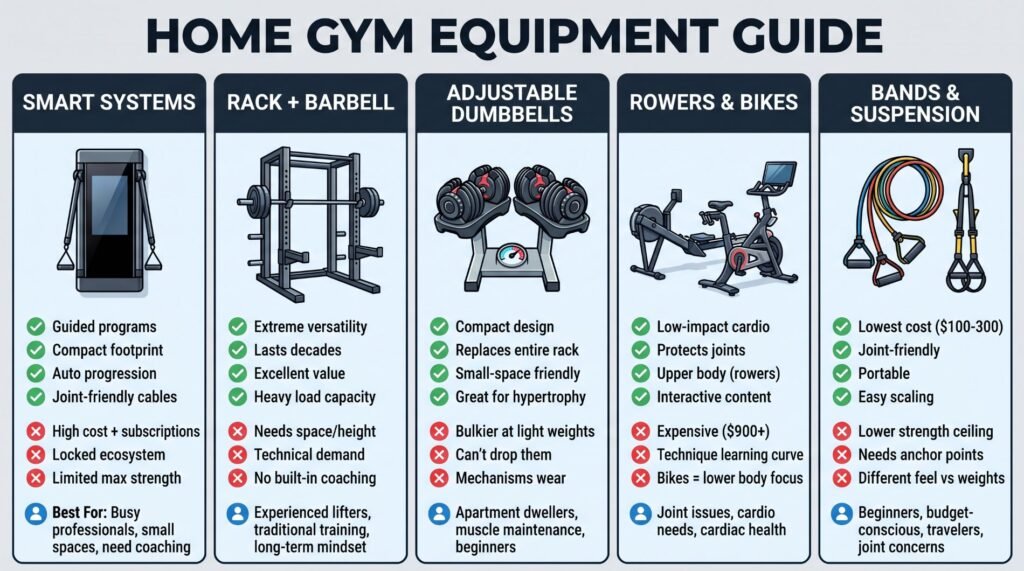
| Equipment Type | Main Pros | Main Cons | Best For |
| Smart Systems (Tonal, Speediance) | Guided programs, compact footprint, automatic progression, joint-friendly cable resistance | High upfront cost, ongoing subscriptions, locked into ecosystem, limited for maximal strength | Busy professionals, people who need structure and coaching, small spaces |
| Rack + Barbell (REP PR-1100) | Extreme versatility, lasts decades, excellent long-term value, supports heavy loads | Requires more space and height, higher technical demand, poor form irritates joints, no built-in coaching | Experienced lifters, people who want traditional barbell training, long-term investment mindset |
| Adjustable Dumbbells | Compact, replaces entire rack, ideal for small spaces, great for higher-rep hypertrophy work | Bulkier than fixed dumbbells at light weights, can’t drop them, mechanisms can wear with abuse | Apartment dwellers, people prioritizing muscle maintenance over maximal strength, beginners |
| Rowers & Bikes | Low-impact cardio, protects knees and hips, rowers add upper body work, interactive content improves adherence | Quality machines are expensive ($900+), rowing technique takes practice, bikes focus mostly lower body | People with knee/joint issues, anyone needing cardio without running impact, cardiac health priority |
| Bands & Suspension Trainers | Lowest cost ($100-300), extremely joint-friendly, portable, easy to scale by adding heavier bands | Lower absolute strength ceiling than barbells/machines, setup requires good anchor points, some prefer feel of weights | Beginners, people on tight budgets, travelers, those with significant joint issues |
Smart Systems (Tonal, Speediance)
The guided programs and automatic progression reduce decision fatigue and help keep workouts under 30 minutes. Compact footprint means Tonal mounts to the wall and Speediance is freestanding and relatively small.
Cable-style resistance can be easier on joints than heavy free weights if your form isn’t perfect.
Downsides include high upfront cost, plus ongoing subscriptions for content. You’re locked into a specific ecosystem, so attachments and future compatibility depend on the brand staying in business.
If you love heavy barbell lifts, these systems may feel limiting for maximal strength goals.
Classic Rack + Barbell
Extreme versatility covers squats, deadlifts, presses, rows, and pull-ups. These things last decades with basic care.
The REP PR-1100 sits far below average rack pricing while still supporting 700-lb loads.
Downsides are that it requires more space and ceiling height. Higher technical demand means poor form can irritate joints fast, especially for older lifters.
There’s no built-in coaching unless you add third-party apps.
Adjustable Dumbbells
Compact and effective design means one pair replaces an entire dumbbell rack. Ideal for small spaces and apartment setups.
Great for hypertrophy-style training and joint-friendly higher-rep work.
Downsides are that some models feel bulkier than fixed dumbbells at light weights. Drop-safety limits mean you generally shouldn’t drop them from height, which affects heavy failure sets.
Mechanisms can wear if you abuse them, though reputable brands test durability pretty well.
Rowers and Bikes
Low-impact cardio protects knees and hips better than running. Rowers add meaningful upper-body and core involvement.
Interactive content from Ergatta, Aviron, and Peloton improves adherence.
Downsides are that good machines aren’t cheap. Mid-tier rowers and smart bikes sit in the $900+ range.
Rowing technique takes a little practice to avoid back irritation.
Bikes focus mostly on lower body, so strength work still needs separate equipment.
Bands and Suspension Trainers
Lowest cost of entry means full starter kits under $100-$300 in many markets. Extremely joint-friendly and portable.
Easy to scale by adding heavier bands over time as you get stronger.
Downsides are that absolute strength ceiling is lower than heavy barbells or machines. Anchor points and setup matter, and poor anchoring can be a safety issue.
Some people simply prefer the feel of weights.
Who Should Consider This
Aging Lifters with Joint Pain and Stiffness
If your knees, hips, or lower back are your limiting factor, equipment choices matter more than how much weight you can move.
Most joint-conscious users do well with smart cable systems (Tonal 2, Speediance) for guided, controlled resistance. Rowers or bikes work better than treadmills for cardio.
Bands and suspension trainers handle accessory work and recovery days.
Heavy rack work can still have a place, but it should sit on top of solid technique and realistic expectations.
Many older lifters switch to more front-loaded squats and dumbbell variations, higher-rep moderate-load training, and extra emphasis on warm-ups and mobility. These adjustments are pretty common in coaching practice even though product lists don’t usually spell it out.
Busy Professionals and Parents
If you regularly start and end the day with meetings, kids’ activities, and errands, the winning setups are smart trainers with short pre-built programs (Tonal 2, Speediance), adjustable dumbbells plus a bench for fast full-body circuits, or a single rower or bike if cardiac health and weight control are top priorities.
Most 2026 guides emphasize that you can build effective foundations under $600-$1,000 if you prioritize correctly. Usually that means rack or dumbbells first, cardio second.
People Worried About Muscle Loss and Testosterone Decline
Strength training is one of the main tools for countering muscle loss and hormonal decline with age.
To make that sustainable, choose tools you enjoy enough to use three times per week. Emphasize multi-joint lifts (presses, rows, squats, hinges) with progressive loads.
Mix in low-impact cardio for overall health and recovery.
Tonal/Speediance, adjustable dumbbells, and a basic rack all support this goal.
People who dislike tech often prefer a rack plus dumbbells path. Tech-friendly users tend to stick better to Tonal-style systems.
Pick what matches your personality.
Where to Buy / How to Get Started
Most of these products are available through major online retailers with dedicated fitness categories, brand-direct websites (REP Fitness, Bowflex, Peloton, Concept2, TRX, etc.), and regional sporting goods chains depending on where you live.
Testing reports from Garage Gym Reviews, BarBend, Men’s Journal, CNET, and others often include price ranges and warranty notes worth checking before you commit.
A Simple Step-by-Step Plan
You can approach this in stages based on budget.
Stage 1, Under $100-$200
Buy a decent exercise mat and a set of resistance bands. Learn banded squats, presses, rows, and core work.
Aim for three 20-30 minute sessions per week.
Stage 2, $200-$600
Add adjustable dumbbells and an adjustable bench. Run full-body strength sessions (push, pull, legs, core) 2-3 times per week.
Use bands and bodyweight for extra joint-friendly volume.
Stage 3, $600-$1,500+
Decide between a rack plus barbell path or a smart trainer path.
Rack path means REP PR-1100 plus barbell and plates if you enjoy free weights and have space.
Smart path means Tonal 2 or Speediance Gym Monster 2 for guided, compact training.
Add a rower or bike when budget allows if low-impact cardio is a priority.
Before you buy anything in Stage 3, I’d compare a “Stage 2” dumbbell plus bench bundle against a “Stage 3” smart trainer with subscription. Look at the long-term cost over 2-3 years, not just the sticker price.
Conclusion: Is It Worth the Hype?
Looking at 2026 testing across many review labs, the hype around modern home gym equipment has real substance behind it.
Smart setups like Tonal 2 and Speediance Gym Monster 2 genuinely help busy people stick to short, structured workouts with safer loading and clear progression.
Classic tools like the REP PR-1100 rack, adjustable dumbbells, and rowers/bikes deliver proven strength and cardio training, often at better long-term value.
Budget-conscious kits built around bands and suspension trainers still give aging joints and busy schedules plenty of training stimulus.
The hype only turns sour when people buy gear that doesn’t match their joints, schedule, or preferences.